Seating Carl against a wall and bleeding him with decals
Carl now sits on the floor with his back to the wall, a fist pressed to his side, and a stain painted in script on his coat. No model was rebuilt for either.
Chief Scientist Carl now sits on the floor of the Breakout Site with his back against the wall by the chest. One leg is out in front of him, the other knee is drawn up, his right fist is pressed to his left side, and there’s blood on his coat, on the fist and on the floor under him. It’s the loop he had standing, just lower: shallow breaths, and once every 8 seconds a wince where his shoulders leave the wall by 28 mm and settle back.
This is what I asked for after I saw the standing version. I said I liked the animation, but he should be sitting on the ground leaned against the wall and he should have blood on him. Shown this film, I said the pose and the amount of blood were right, so I’m keeping both. What’s left is his corpse, which has no blood yet. The creation scene’s Carl, who stands at the table, is still clean and standing on purpose.
How do you make a seated clip out of a standing idle?
Like the standing one, it’s 14 layers on the human body’s base idle, 192 frames, an 8 second loop at 24 frames per second, kept as a JSON file beside the body so that the body and the 35 pieces fitted to it aren’t rebuilt. The hips joint is 0.14 m up and the pelvis is rolled back 28 degrees. The trunk is curled forward 28 degrees so the shoulders rest on the wall. The left leg is out on its heel with the toes up 62 degrees, the right knee is up with the sole flat, and the head is back and a little to one side.
The motion kit couldn’t place a foot like that, so I added to it instead of making a one-off. The foot layer now takes where the ankle goes in the room, how far the foot tips about its own side axis, where the knee points, and how high the foot’s lowest point is off the floor. The bench check gives any clip with “seated” in its name a new line. It fails if the skin goes under the floor, if the seat is more than 15 mm off the floor, or if the back goes past where it leans. The standing rule that keeps the soles on the floor still applies to the lower foot.
The numbers on the finished clip: the seat is -1.0 to -0.6 mm from the floor, the back is 242.5 to 284.6 mm behind his origin, and in the wince the left fingers dip 7.9 mm under the floor, inside the 15 mm limit. The loop’s seam is a step of 0.04 degrees against 1.90 for the largest other step.
Four things cost time. A foot’s skin is only the forefoot, and the heel belongs to the shin, so a foot standing on its heel sits 77 mm lower than the foot bone says. The bare belly is 5 cm inside the coat, so a fist posed on the skin vanished into the cloth until I posed it 5 cm proud. Trunk numbers that look upright on paper lean back about 10 degrees more, because the base idle has its own lean. And the content schema has to know about any new sheet refinement, or the validator prints an error.
How does a sitting NPC fit in the room?
The figure’s third word says how it rests, and human/01/wounded_seated is its own word, so wounded is unchanged. A figure is seated when that word ends in “seated”. Three small blocks in npc.gd check it. The name shows over a head at 0.52 of his height, he doesn’t turn toward the party because a turned body would put his back through the wall, and a low box, 0.7 by 0.5 by 0.85 m, goes over his legs so the party can’t stand in his lap.
Carl’s place comes from the dungeon sheet’s npc@15,5, which is put against the nearest wall. I added a refinement, "back", for the distance from the wall to where he stands. It defaults to 0.6, the schema allows 0.15 to 1.5, and Carl’s is 0.3. That’s his own square moved 0.3 m back, which leaves about 2 cm between the coat and the wall.
Why is the blood a decal?
My first thought was a tint or a changed garment. A garment’s bytes are held by the model pipeline, so changing one means rebuilding it, and an NPC’s tint and a corpse’s pallor are washes over the skin’s material that a stain wouldn’t survive. So the blood is two Decal nodes, painted in script, and no model was touched.
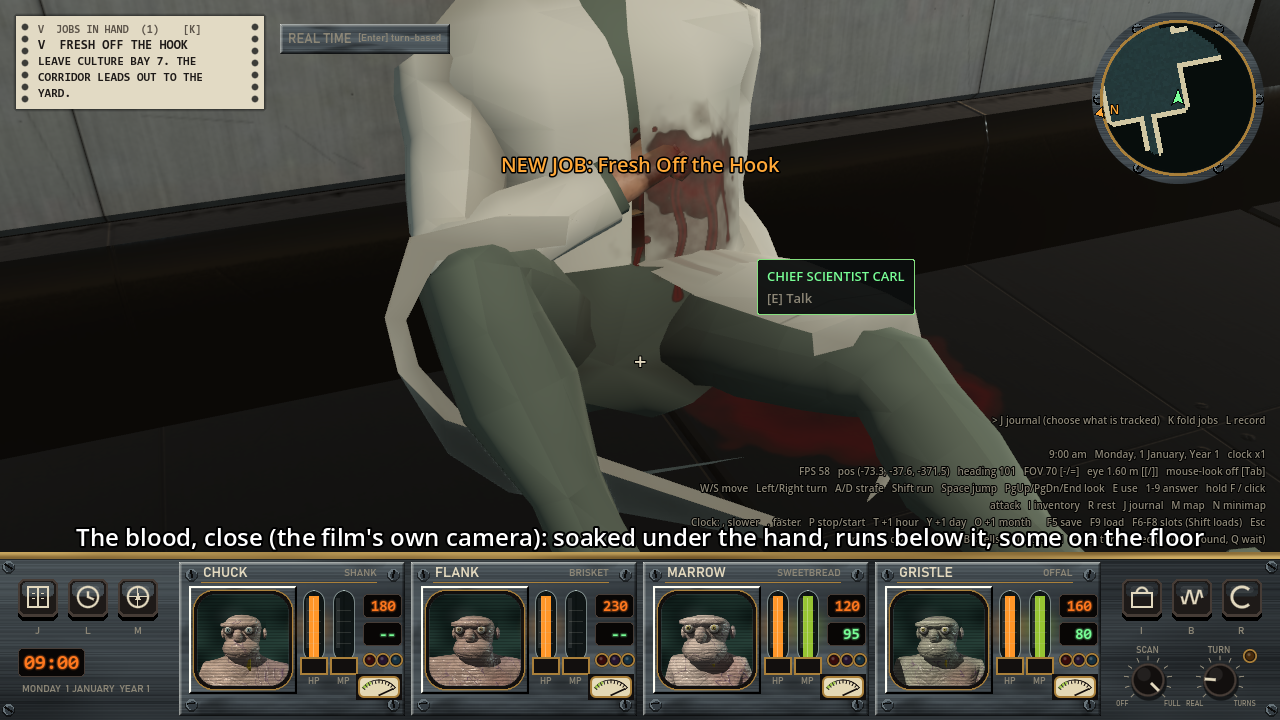
The blood close up, rendered in game: soaked under the pressed fist, runs below it, and some on the floor between his legs.
Any figure whose third word starts with “wounded” bleeds, so the standing one does too. A BoneAttachment3D on the spine bone carries a Decal 0.30 by 0.30 by 0.44 m, so the stain moves with the breath and the wince. It’s thrown from his front left onto whatever is there. That’s the coat, the shirt under it, bare skin on someone who wears nothing, and the fist pressed over the wound, which is how the hand gets bloody. normal_fade is 0.35 so it doesn’t wrap onto surfaces facing away, like the far side of an arm. Someone who sits also gets a second Decal on the floor, 0.78 by 0.07 by 0.66 m, thin enough to wet the floor and the seat and no more.
The stain is a 192 by 288 pixel picture painted in the script once per run from fixed numbers, never randf(), so it looks the same every time. It’s built per pixel from noise at two scales: a ragged blot wider than it is tall, three runs that leave it (thin where they ran, a bead where they stopped), six drops, and a paler halo where the cloth drew it out. The color goes from a dried brown at the edges through a wet red to a near black at the middle.
What’s left
The dead Carl has no blood yet. The creation theatre’s Carl needed no change, because it keeps only the first two words of his figure, so it stands clean. Motion I judged from the film and the stills. tests/figure_clips went from 34 checks to 63 and all pass, and the tests I ran by word on the merged result, 10 of them, all pass too.