Building meat monsters from the character body generator
A body generator for a limbless sack, a four-armed beast and an ogre, one skin for the family, and why only the sack is in the game so far.
The Meat Sack has its own body in the game now, built with the same generator kit that makes the playable characters. It’s 2,991 triangles, 6 bones, 0.897 m tall, with five clips (idle, walk, attack, hit and death). It’s one of four, though. The Meat Boy, the Meat Beast and the Meat Monster exist as skinned models on a look sheet and can’t go into the game until I fix a limit in the motion step.
Why did the first four look like toys?
I asked for four meat monsters to replace the dungeon’s, and said they didn’t need sockets or equipment, “they can just be raw monstrous bodies”. The first worker took me at my word and built them from rounded blocks on the small creature kit. When I saw the sheet I said they looked “very cartoony and basic” and that they should be made by generators, doing all the same things as for the regular characters, just without sockets and equipment.
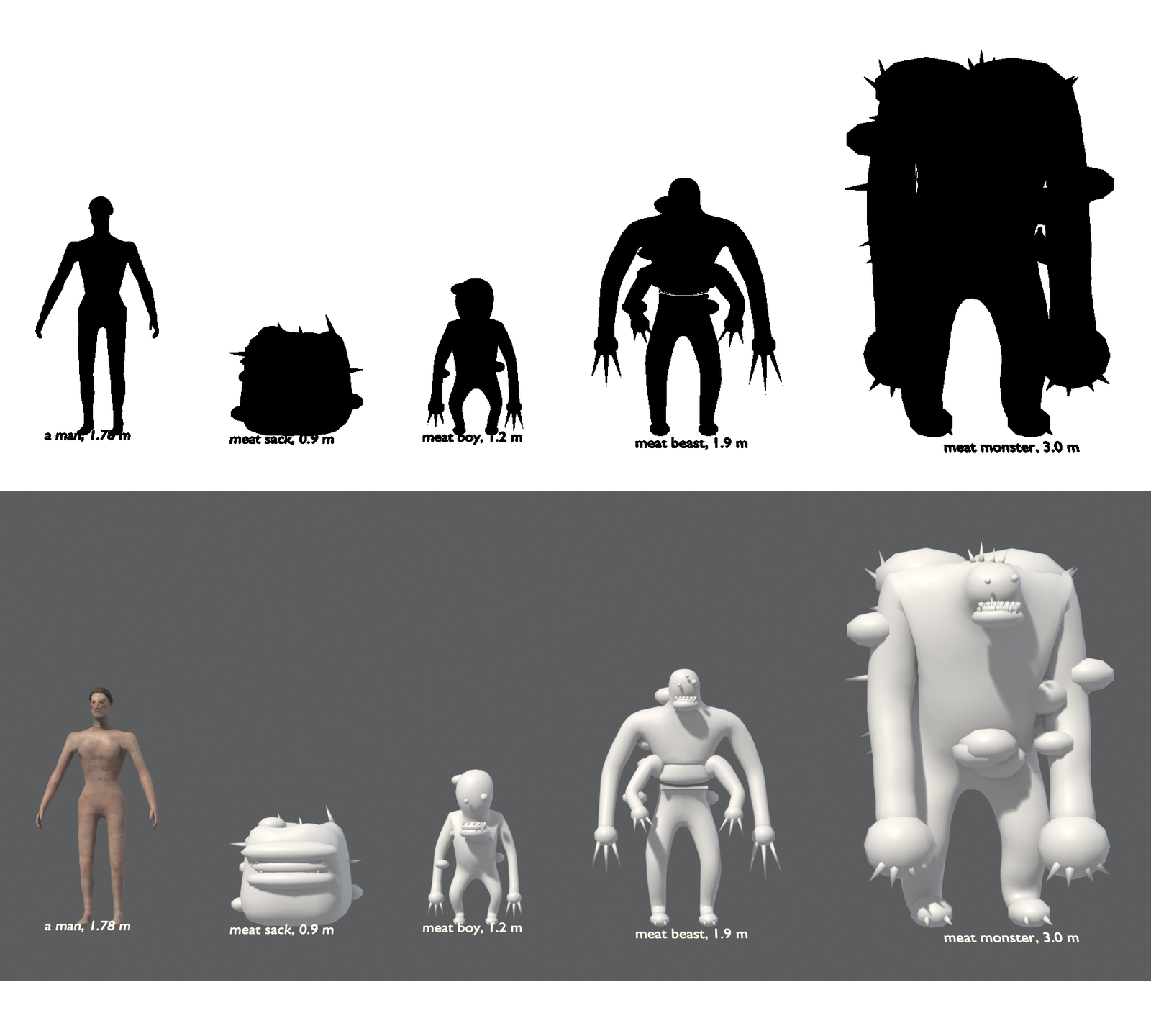
The first sheet, as silhouettes and grey meshes beside a 1.78 m man. This is the one I called cartoony.
So the bodies were rebuilt on the body kit, the one with sectioned limbs, muscle and fat forms, elbow and knee fans, and painted skin. A head with a jaw and teeth comes from the face kit. The kit didn’t have a second pair of arms, a body with no limbs, or a way to cut a 3 m trunk finely enough, so those went into a new module next to it. Nothing in the existing kits changed, which means the playable bodies can’t have changed either.
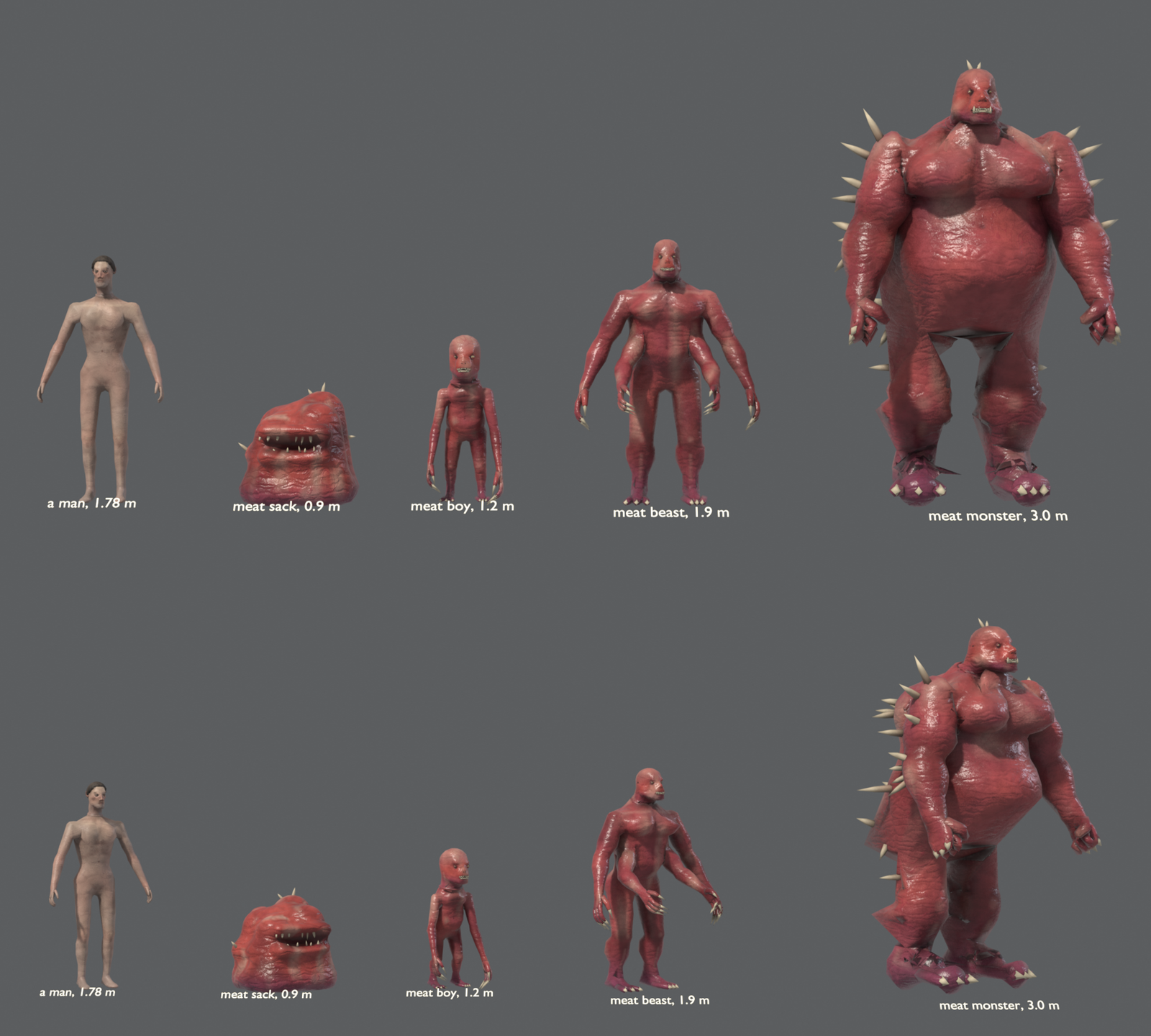
The second sheet, skinned and textured, front and three-quarter views. I picked ‘Yes: build these’.
How does a body get a second pair of arms?
The body kit builds a trunk as a grid of rings and columns and cuts one hole in it for each arm. For the Meat Beast I cut a second hole on each side, a few rows below the armhole and turned a little to the front. Then I run the kit’s own arm functions again on a second set of joints, so the lower arm gets the same muscle masses, limb rings, elbow fan, hand, fingers and claws as the upper one.
The only trick is that those functions read an arm’s joints by name. A small swap puts the lower arm’s joints where they look, runs the function, and puts the upper arm back. The rim of the new hole is pulled onto the lower shoulder’s mass but never more than a small fraction of the body’s size, which is the kit’s usual settling rule. The lower arm’s bones are upper_arm_low, forearm_low and hand_low under the chest, and its finger and claw parts are named so they ride the right bone.
How do you make a body with no limbs?
The sack has no joints to build rings around, so I made it the way heads are made. Its shape is a handful of masses, four slumped bundles of muscle, melted into one distance field with a smooth minimum. A ball of quads is then shrunk onto that field from a core point inside it. The ball is a 15 by 15 grid per face, 12 triangles per square, and then it’s relaxed. That’s the face kit’s wrap function, used on a body.
Teeth, claws, shards and spikes come from numbers too. Each is a short lathe profile, rooted in the skin and sunk some multiple of its own radius into the flesh. To place a spike, I find the nearest point on the skin and stand it along the skin’s normal there. The Meat Monster’s 41 spikes are made this way. A tooth gets a direction instead, because teeth hang and don’t bristle.
Why did the sack’s teeth leave gaps?
The sack has no joints, so it moves by leaning, opening its mouth, and swelling and slumping through bone scales. On the idle clip the belly bone breathes to 1.045 across and 0.97 high, and in its death clip the hips drop to 0.80 of their height. A tooth that’s rigid on a bone doesn’t scale with the skin around it, so the pipeline’s gap check found gaps in the clips.
Two changes closed them. The upper teeth and the shards are weighted as flesh, so they swell with the body, and the lower teeth are rigid on the lip bone, which opens and closes the mouth. The tooth at the edge was dropped. After that the sack had no gaps in any of its five clips.
How do four monsters share one skin?
They share one skin, but not one size. The family’s raw meat is a noise coat laid over the body kit’s colors: wet patches, strands of fat and sinew that run down the limbs, dark where the muscle is deep, and bruise purple near the floor. The noise scales with the square root of the body’s height, so a 3 m body’s strands aren’t a 1.2 m body’s and aren’t 2.5 times them.
My first attempt used the orc’s crease numbers, and raw meat read as scales, with stripes across every limb. The family’s creases are now a fine, shallow web and the hand-wide bands are gone.
The big body needed one more fix. The body kit counts its rings for a man, so on a 3 m body the 24 rings around the trunk are facets a hand wide. A finer setting cuts every square of the body’s skin into four before the skin is slimmed, and leaves the head alone because the face kit has already cut it.
Why is only the sack in the game?
The model pipeline records every step a model passes, and the install gate refuses a model whose record is incomplete. The sack’s record is complete and it was built three times to the same bytes. For the sack, the step that compares a new model with the one it replaces was skipped, because I’d answered that the four replace nothing.
The other three carry the playable bodies’ 24 bones plus a jaw, so they can use the shared walk, hit and death clips. But the pipeline’s motion step refuses a jaw bone at the bake and fails any jaw that opens, because it checks every bone on the exported file to within half a degree. The bench that makes the clips also expects a separate head file and a weapon socket, and these bodies have neither. I didn’t want to fall back to 20 bones and typed angles, since that’s what made the old bodies stiff. So the motion step has to learn about bodies with their heads welded on, and every playable body’s record has to be shown unchanged afterwards.
I picked the look on the film too. The shape is approved, but I want the sack paler and wetter so it stands out from the meat-grown walls. That isn’t done either. Fourteen of the Meat Monster’s spikes also still show gaps in two poses and need the same weighting as the sack’s.