Tuning four meat monsters by hits to kill
Four melee monsters sized by how many hits a new party needs, one table of numbers, and 58 of them placed across the dungeon's four floors.
The Breakout Site has monsters in nearly every room now. I took out its three old packs and put in 58 single monsters of four new kinds, a Meat Sack, a Meat Boy, a Meat Beast and a Meat Monster, with the Meat Monster as a boss alone on the top floor. The bodies are stand-ins for now. The sack and the boy wear a goblin, the beast a lizard and the boss an orc, scaled to their heights. The real models are being built separately.
Why count hits instead of picking health?
I asked for it in hits: a brand new party kills a Meat Sack in two to three hits, the Meat Monster in about 15, and the other two step up in between. I also wanted them in basically every room except the one the party wakes in, all with melee attacks, and the boy with a ranged spit as well.
“A hit” needs a hitter, so I settled on one member of the new party using a basic attack. A new game’s party starts with nothing, so I counted them armed from the Vat-side Locker, which hands each member a tier 1 weapon and the class’s first procedures. The tests use the shipped classes, not the frozen test ones. I picked this reading when it was put to me, over counting bare hands.
How is a health number made to fit a hit count?
Each of the four members hits differently. Chuck’s Samurai cleave does about 103 every 2.8 seconds, the Berserker’s does 168 every 3.3, and the two casters use Bile Bolt, 58 and 76 a cast. So the same monster takes one member 1.86 hits and another 3.
A test builds the party, outfits it from the locker, works out the hits from the real damage rules and prints this table. It fails if an average leaves its band.
              health  Chuck  Flank  Marrow  Gristle  average
Meat Sack       170    1.86   2.00    3.00     3.00     2.46
Meat Boy        400    4.50   3.00    7.00     6.00     5.13
Meat Beast      750    7.79   5.00   13.00    10.00     8.95
Meat Monster   1250   12.04   8.00   22.00    17.00    14.76
So the health is 170, 400, 750 and 1250, and changing one means running the test again. There are no resistances, on purpose. If a kind resisted one starting weapon, it would take more hits from one member and fewer from another, and the count I asked for wouldn’t be true for anyone.
How hard do they hit back?
I set what they deal back against how long each lasts when the whole party attacks, about 116 damage a second. Alone, a sack lasts around 1.5 seconds, a boy 3.4, a beast 6.5 and the Meat Monster 10.8. The members have 140 to 200 health.
kind          melee                  speed   height
Meat Sack     12 blunt / 3.0 s       1.7     0.9 m
Meat Boy      22 slashing / 2.6 s    3.3     1.2 m
Meat Beast    42 slashing / 2.4 s    3.4     1.9 m
Meat Monster  120 pierce / 3.4 s     2.3     3.0 m
The Meat Monster’s 120 looked high against members with 140 to 200 health, and I kept it. The Meat Boy also spits 16 poison every 3.8 seconds from up to 16 meters, but only while the party is more than 5 meters away and in sight. Closer than that, or out of sight, it comes in and claws. That’s one small AI class on top of the chase AI, and the spit is the Gristle Spitter’s existing shot.
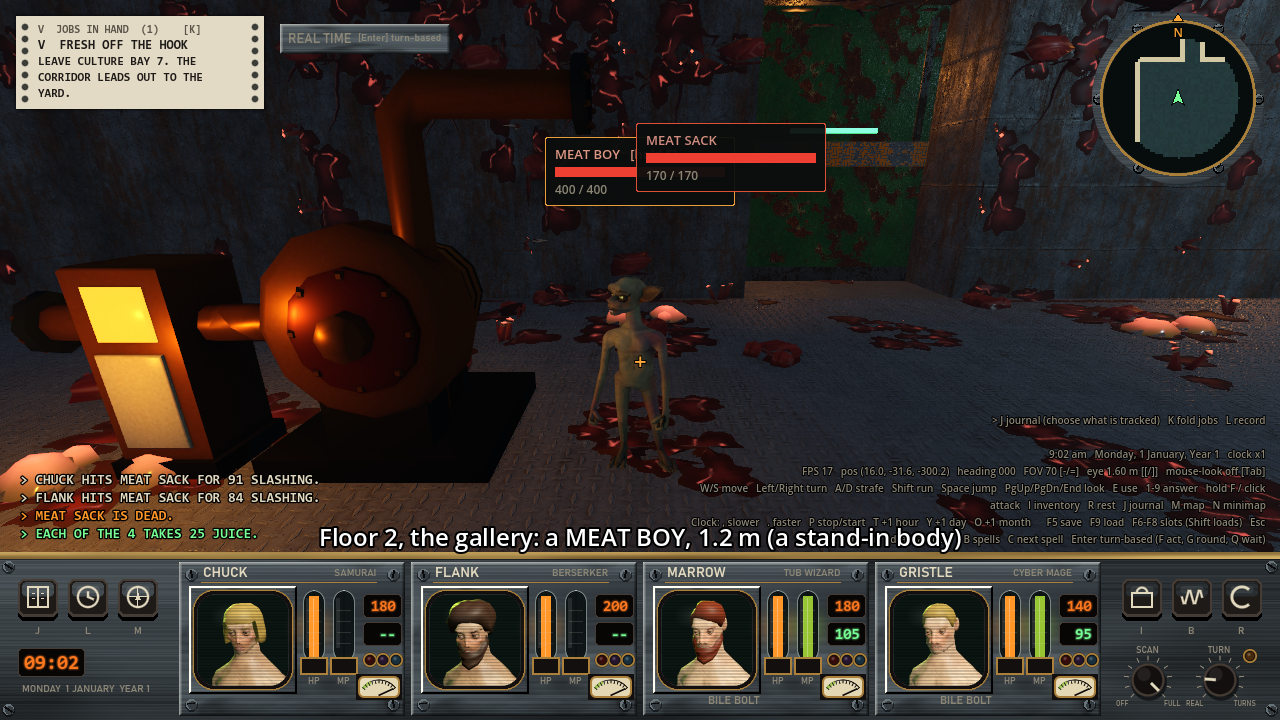
A Meat Boy in the floor 2 gallery, on a goblin stand-in at 1.2 m.
How does a stand-in body get swapped for the real one?
Every number lives in one table, one row per kind, so a new kind is a new row. It holds the name, health, speed, melee damage, interval and reach, the spit, the typical height and the hit box. Individuals vary 8 percent either side of a kind’s height, which is tighter than other monsters get, so the four stay easy to tell apart.
A kind asks for the body of its own id, like meat_sack, and wears its stand-in only while the model table has no row with that name. A model’s row needs the file, its height, five clips (idle, walk, attack, hit and death), the time in the attack clip just before the strike, and how far behind the feet the fallen body lies. When a model goes in, that row is all that changes.
Where did the 58 go?
I made them packs of one on purpose. A pack’s formation spreads its members up to 3 meters, a whole square, which pushes them into walls in a one-square corridor. A single’s square can be checked exactly, and a script checked every one and printed a map for each floor.
- Floor 1 has 34 sacks and 2 boys.
- Floor 2 has 5 sacks and 4 boys.
- Floor 3 has 4 beasts and 4 boys.
- Floor 4 has 2 beasts, 2 boys and the Meat Monster alone in the Tower’s Foot.
The weak kinds are low and the strong ones high. Some rooms are empty on purpose. The surgery the party wakes in is, and so is the corridor south of it, since it looks straight in. The burst vat’s pit, the cell of Subject 29 (he’s alive) and the lift landings are empty too. A monster only walks in straight lines, so a room with a monster in it fights together when one is called, within 8 meters. They don’t wander.
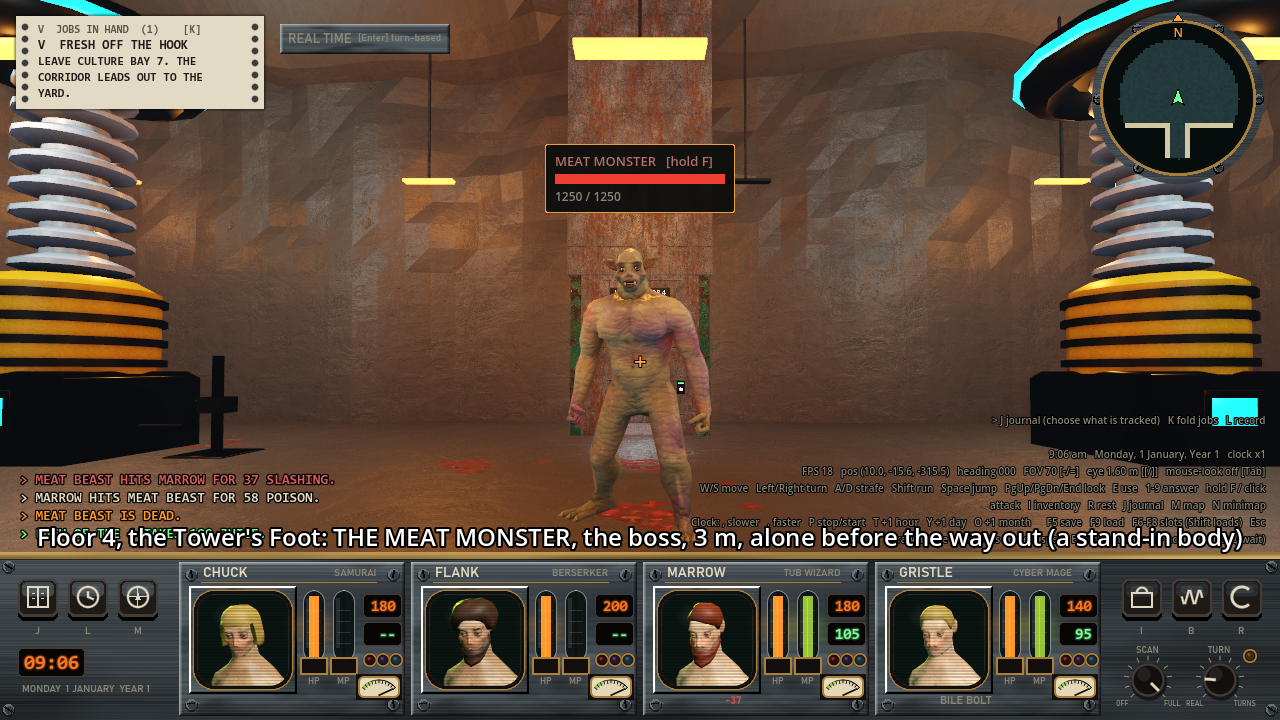
The Meat Monster alone in the Tower’s Foot on floor 4, on an orc stand-in at 3 m.
One sack ended up standing on the mouth of a crawl space in the first cell, so I moved it a square. Two tests had to change too, one counting the old packs and one that said a dead body is worth no less than the cheapest kill, which is now a sack’s 100.
Before the merge I ran the tests whose names matched the monsters, combat and the site, 26 in all, and none failed on their own. One check that watches the folders the game saves to failed, but only because I was playing at the time, so that isn’t a pass of the whole suite. A kill pays 100, 220, 400 and 1000 juice, and I’m keeping those and judging them from play. I was asked whether 58 monsters, 36 of them on the first floor, was the right amount, and I decided to keep it.