Modeling the Alien's tentacle-legged dog in Blender
A hound with octopus-arm legs and a very long neck, built from my sketch over five judged rounds, with Effigy used only to settle the shape.
The Alien’s pet dog is modeled now. It’s a hairless pink-gray hound with a deep chest, four tentacle legs with suckers and curled feet, a very long neck and a narrow head with two eye stalks. It has idle, walk, run, attack, hit and death clips, it’s 5,975 triangles, and it’s installed in the game. Nothing uses it yet. The pet system, where it follows the party and fights, isn’t done yet.
Why a dog with a very long neck?
I decided the Alien’s special ability is that it keeps a dog as a pet that follows the party around, and that the dog grows with the Alien’s machine skill and does about 60 percent of the Alien’s combat damage. I drew it in pen beside the Alien as “a normal dog’s body with tentacle legs and a very long neck”. It was also the first time I used Effigy, an AI 3D tool, to settle a shape. I wanted to see whether that’s cheaper than modeling a shape blind.
How did the shape get settled?
Effigy made concepts from text, and three of them became bare gray 3D shapes. I picked one and measured it: the back at 0.90 m, the body 0.95 m long, the neck 0.55 m, the head 0.33 m. Effigy’s mesh is only a target. The dog is built in the Blender kit I use for the Alien, with a rig, clips and paint of its own.
The generator works the way the Alien’s does. The body is a lump, where chest, waist and haunch masses are melted into one field and a ball of quads is shrunk onto it. The head is a second lump. The neck, the four legs and the tail are tentacles, tapered tubes along a smooth curve with their roots sunk in the body. The legs have 40 raised suckers in two staggered rows, and the eyes sit in bulbs on stalks. It all has one material and three 1024 textures. The bones follow the limbs’ curves, and every turn in a clip is about a world axis or the limb’s axis, which is what let me measure the head’s pitch in the attack.
What did five rounds of judging change?
A separate judging agent looked at turnarounds at 2, 5 and 12 m, the clips’ key poses and a 40 pixel silhouette each round.
The first round said it matched my sketch but also looked like a pink llama, a tube of a trunk on an A-frame of legs. So the chest got a keel, about 0.40 m deep at the shoulder tapering to 0.18 m at the waist, and the legs got a taper, a curl and suckers on every leg. The wind-up of the bite also pointed the muzzle straight up, and that failed twice, so before round 3 I fetched greyhound and saluki references for how a head is carried. Round 3 leaned the neck forward and widened the chest, and round 4 went to the head.
It was still a little llama from the front at 5 m, so I asked for one more round. Round 5 tapered the neck from 0.10 m at the root to 0.055 m under the throat and leaned it to 34.4 degrees from vertical, up from 23.4. The chest went from 0.313 to 0.367 m wide, the front feet moved 0.06 m further apart, the fangs got 30 percent shorter and the stalks 10 percent thinner. The judge cleared all seven items. What’s left of the llama from the front is the long neck I drew.
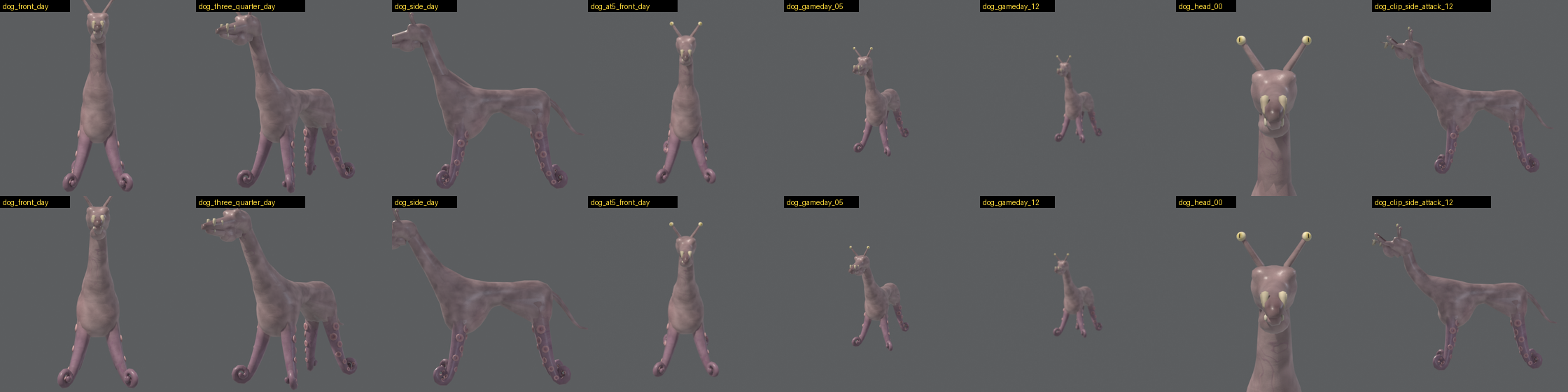
Round 4 on top, round 5 below. Look at the neck and the chest in the first two columns.
I added what the judge and I agreed to the kit’s defaults before the next round. There are now ranges for a neck’s lean, its share of the chest’s width and the throat’s share. There’s also a seam blend: where the neck, legs and tail leave the trunk, the vertex colors blend over 0.04 m and the normals are averaged. The jagged band across the chest turned out to be a kink in the shading, not in the color, so the normals mattered as much as the paint.
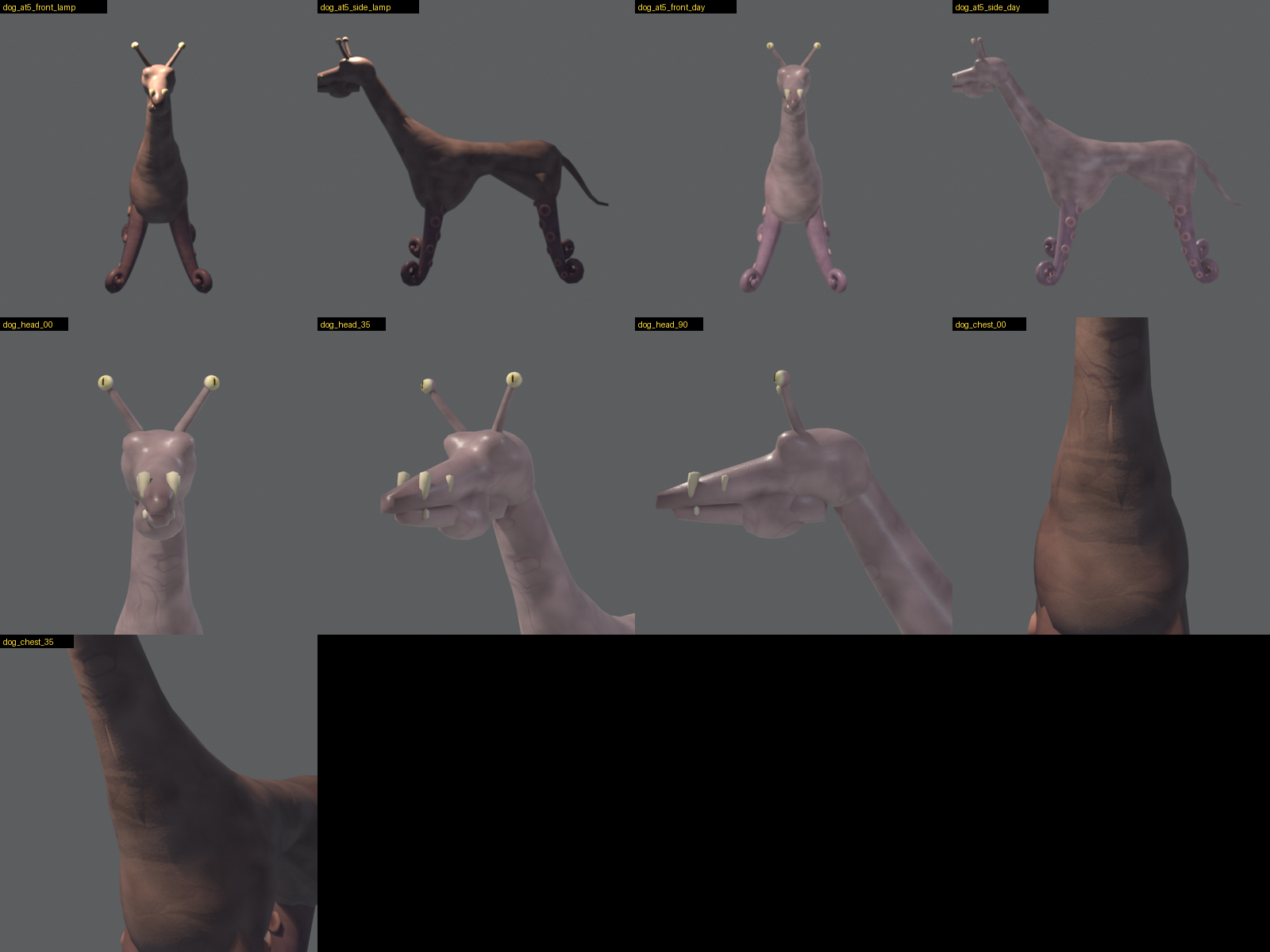
Front and side at 5 m in lamp light and by day, then close shots of the head, and the chest where the neck starts.
What didn’t work?
The judge found one small thing left. The upper fangs poked about 0.01 m through the top of the snout. I tried trimming the fang roots, and then putting solid balls of head around each root. Both left a gap in some bite frames, because the snout’s underside is half weighted to the jaw and the bite pulled it away from the trimmed roots. I reverted both. I said I wanted to accept the dog as it was, so the installed model is exactly the round 5 build. If it’s ever wanted, the snout flesh around the roots has to be head only, or deeper, before trimming.
The first review sheet also cut the head off, because I’d set the camera for a straight neck. That was a fault in the review, not in the model.
The dog test checks 33 things and all pass, and the 5,975 triangles are under its 6,000 budget. The film is 39 seconds, with the dog next to the 1.90 m Alien. It’s 1.56 m to the tops of the eye bulbs.
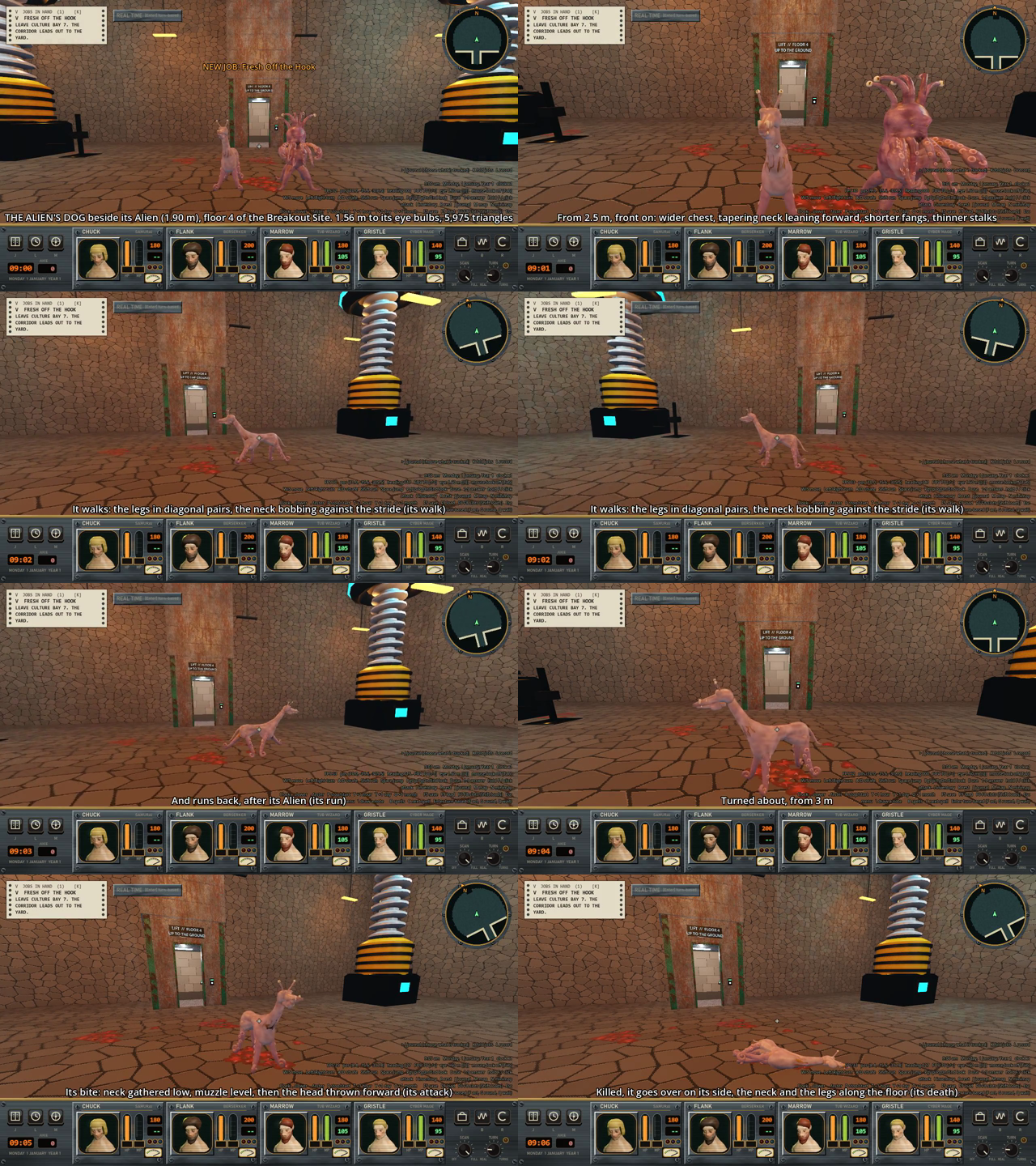
Contact sheet of the film, from standing to the death clip.