Modeling themed dungeon doors in Blender and Godot
Every dungeon door now follows its floor's theme, from sliding brass bulkheads to swinging oak, and the blast door becomes a maw or a portcullis.
Every door in the dungeons now looks like it belongs to its floor, and none of them wears the old painted plates. I built 48 door models, a frame, a leaf, a blast door and a broken door in each theme, new and worn. Cyberpunk and steampunk doors slide into their jambs, and eldritch and fantasy doors swing.
Why did the doors need to change shape and not only color?
A lot of the doors were still the old placeholder, and I wanted them to follow the style and theme guides. The rule in those guides is that a theme changes the form of a thing, not only its color. A door is something the player uses, so it also carries a glowing indicator in its theme’s form.
So the leaf, the frame, the lock and the light all change per theme. Steampunk has riveted brass plate in an angle-iron frame, with a valve lamp behind smoked glass. Eldritch has rounded bone ribs over cracked stone, in an uneven arch of bone and stone, with an eye for a lamp. Fantasy has oak boards on gilt straps, in posts and a beam, with a set stone over the lintel.
How is a door built, and what does the game draw itself?
The doors are one family of pieces in the interior kit. A square’s door is a frame and two leaves. A passage’s door is a narrower frame and two leaves, and it always slides, because a swung leaf would stand inside the passage’s walls. The blast door is two halves, where the upper half is the lower one turned about the way through, so the teeth fall between each other. The broken door is one leaf off its track.
Each theme is a few keys in the kit’s spec: the leaf face (panel, riveted, ribbed or planks), how it opens, the frame form (plain, angle iron, bone, timber) and which blast door it uses. A swung leaf is only 6 cm thick and its face is at most 2 cm proud, so when it’s open it fits between the opening and the skirting.
The lock and the status light aren’t modeled. They change, since the light goes red when the door is locked and green when it’s free, so a class called DoorDress draws them in code for each theme. A second class, DoorLook, decides which pieces a door uses. The theme is the floor’s, and if that theme doesn’t have the piece installed it falls back to the interior’s and then to the house door, which is cyberpunk. A launch switch brings back the old plates, which I use for before-and-after shots.
What did the judge find in the first round?
I had a judging agent look at four review sheets and the film. It liked the leaves, but it rejected the round for four reasons.
The film never showed a door shut and well lit. The square teeth of the blast door looked like battlements on fantasy and eldritch, and on fantasy like toy blocks. The cyberpunk door’s yellow lock panel and cyan status bar were on every theme, and every theme still used the cyberpunk frame in a different color. The fantasy oak was nearly black in the game, though it looked right on the sheets. The cause was a metallic value of 0.7 on a surface with nothing to reflect, so I added a per-material lift that raises the oak and gilt about 40 and 25 percent and the steampunk brass about 25 percent for the game’s lamp.
Why a portcullis and a maw?
The judge’s argument was that a blast door is a job, and in a fantasy or eldritch world something else does that job. I asked on the Review Desk, and my answer was “Portcullis for fantasy, fang-maw for eldritch”.
The fantasy portcullis is a grid of black iron bars with spiked feet and oak rails, in one piece that rises whole into the lintel with a set stone at the top. The maw is two halves of cracked stone with jade lips and tapered, uneven bone fangs, with an eye at the seam. Cyberpunk and steampunk keep the industrial door, which parts at the waist.
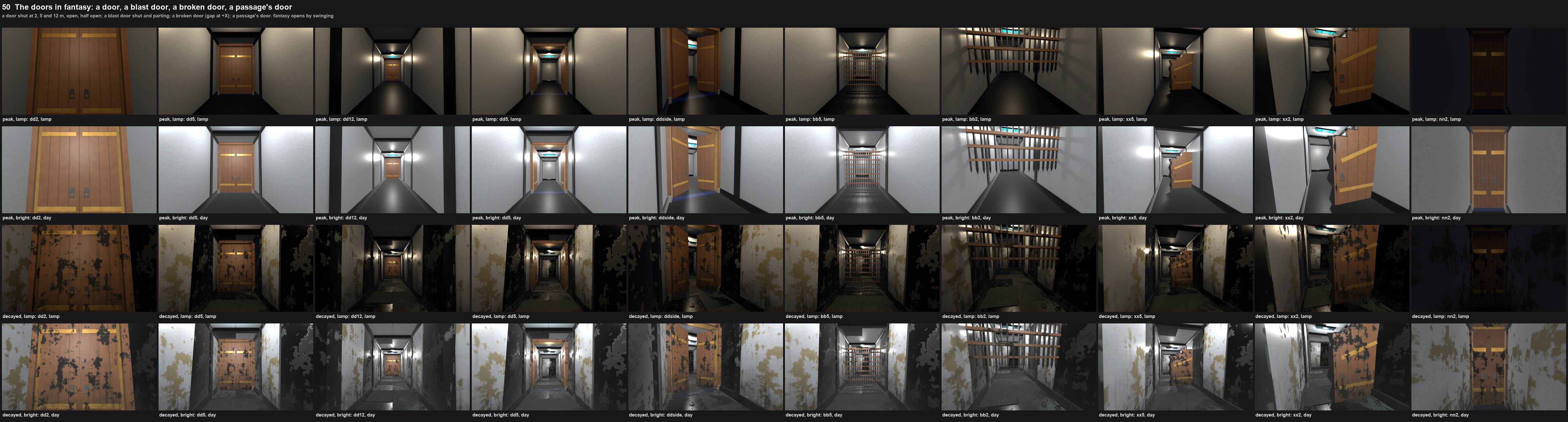
The fantasy review sheet. Doors shut at three distances, open, half open, the portcullis, a broken door and a passage’s door, new and worn, in lamp light and bright light.
The broken door’s torn edge was a regular staircase, so I made it irregular. The fantasy one has boards broken short and a strap hanging off its line.
The second round fixed everything on the judge’s list, and the judge approved every piece. tests/dungeon_doors ran 153 checks with none failing, and the 46 tests I ran on the suite around doors, locks, saves, dungeons and the model pipeline all passed. Then I approved them.
Also done
- Still open are a few small fixes. The eldritch lock still reads yellow like the hazard keypad, there’s a blue strip along the fantasy sill, and the steampunk indicator sits under a hanging ceiling lamp.
- The vent grate in the crawl is still drawn in code, and doors on floors that aren’t laid from pieces are never worn.
- The steampunk blast door’s brass wasn’t lifted like the other steampunk door’s.