Bending straight wall pieces into round buildings
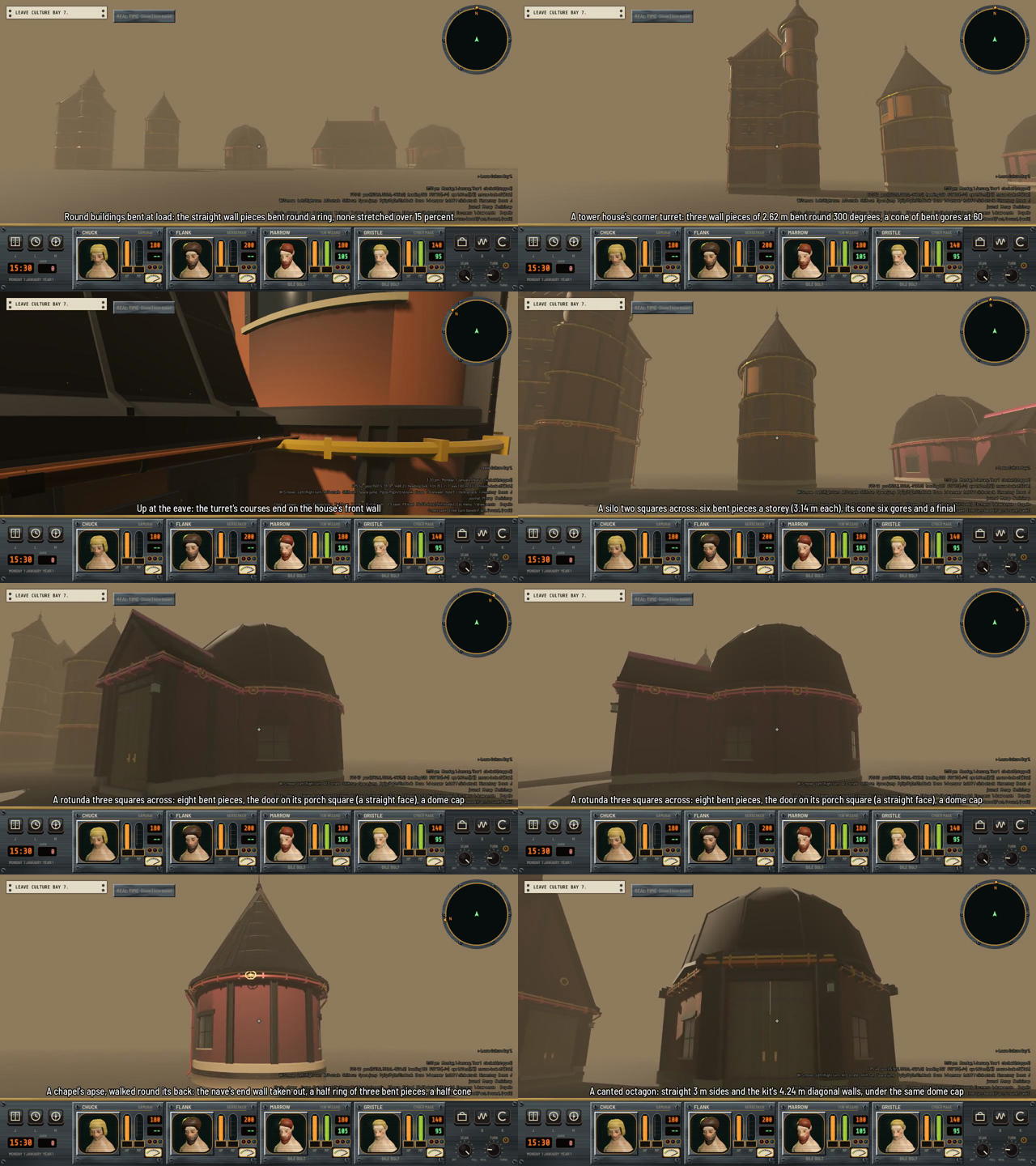
The game now lays a tower house with a turret, a silo, a rotunda, a chapel apse and an octagon by bending its 3 m wall pieces round a ring, with none stretched past 15 percent.
The game now lays round buildings. There are five kinds: a tower house with a corner turret, a silo, a rotunda, a chapel with a round apse and a canted octagon. Their walls are the same straight 3 m pieces the square buildings use, bent round a ring when the building loads. A bent piece may stretch or squeeze at most 15 percent from its 3 m, and a test measures all 546 laid pieces to check it.
Why bend the walls and not model round ones?
I ruled on 21 October that a round building bends the straight wall pieces at load, and that a dome is a made cap. A bent piece may stretch or squeeze at most 15 percent from its 3 m. The caps, gores, finials and diagonal wall came from the previous step. This one lays them.
How are the five kinds built?
- The tower house’s corner turret is three pieces of 2.62 m bent round 300 degrees, with a cone of bent gores at 60 degrees on top.
- The silo is two squares across: six bent pieces a storey at 3.14 m each, a cone of six gores and a finial.
- The rotunda is three squares across: eight bent pieces, its door on a straight porch square, and a dome cap.
- The chapel’s apse takes out the nave’s end wall and puts a half ring of three bent pieces there, with a half cone over it.
- The canted octagon keeps its straight 3 m sides and uses the kit’s 4.24 m diagonal walls, under the same dome cap.
A ring seen from far away is drawn as its own simplified hull. The building shader lays a cone gore’s slates along that gore’s own slope.
Why does the turret stand off the corner?
Because of the limit. On the corner point, 270 degrees of ring would need pieces of 3.53 m, which is over 15 percent. Moving the turret 0.39 m out from the corner brings its three pieces to 2.62 m.
How is it proven?
The test measures every laid piece, 546 of them across 13 plans. The worst is the turret’s, 12.7 percent short. Cone seams have to meet within 1 cm. That is measured from a seam point to the neighboring gore’s surface, because the lapped slate ends put the two seams’ vertex rows at different heights, so comparing vertex to vertex would be wrong. 80 checks pass, and the 16 tests the landing could break pass.
What went back to the maker?
The judge passed the bending in round 28 and sent the branch back for three things. It had been cut before the game read installed parts, so it was brought onto them. The first film looked up 30 to 44 degrees, so walls leaned and no horizon showed. And the test claimed to measure the meshes but only did arithmetic on the plan. Now the test measures real pieces. The film was retaken with each shot’s pitch worked out first and kept under 10 degrees, and the tower house is filmed from 22 m instead of by tilting up. A tall building gets filmed from further back, never by tilting the eye.
What is still wrong?
One known exception, which the test names on every run. The octagon’s diagonal plinth step, plinth course and string course are straight pieces stretched 41 percent, until the kit makes 4.24 m ones. That is a question put to me.