Building domes, cones and angled walls for round buildings
The steampunk kit now makes cone gores, dome caps, diagonal walls and arcades, plus dead domes with a torn edge and a dark hole, ready for round plans.
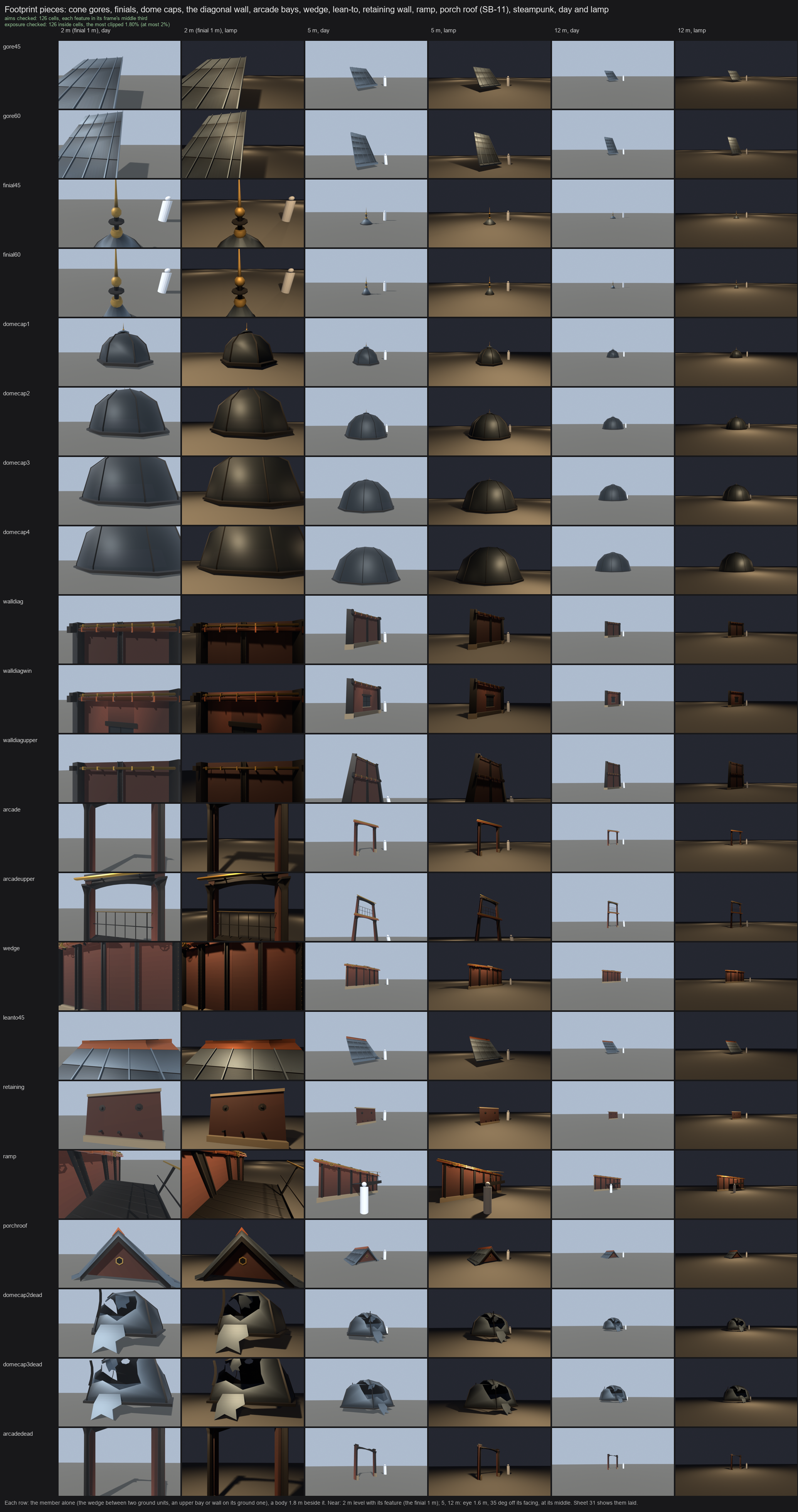
The steampunk building kit now makes the pieces a round or angled building needs. There are cone gores at two pitches with finials, four dome caps, a diagonal wall for the 45 degree corners of an octagon, arcade bays with a gallery above, and a wedge, a lean-to, a retaining wall, a ramp and a porch roof. The domes and the arcade also have dead versions. None of these are laid in a street yet. The game only moved its pin to the kit that has them, and laying them is the next step.
Why aren’t plans only squares?
I decided plans shouldn’t only be squares: circles, cloisters and other shapes. A round building bends the straight wall pieces when it loads, and a dome or a cone is a made cap on top. So the kit needs the pieces that bend, and the caps that sit on a bent ring, before the game can lay a round house.
How does a cone get built?
A gore is one flat plate of a cone. Its numbers put the apex one square in from the wall, on the pitch line, and the plate stops short of that apex. The finial is its own piece, with a skirt that covers the last stretch, so eight gore tips never meet in a pinch. A rule in the kit’s fault checks tests that. A ring of eight gores on a canted octagon drum is a cone, and each facet of the drum takes one gore.
The diagonal wall is the piece for the 45 degree joint between a plain wall and the next. The corner column covers the joint, so the plinth and the panel band run on with no step.
The ramp is a deck on knee plates with rivets, laid on three wall stubs so its middle is 2 m up at 8 degrees. One 3 m piece can’t show that it is a ramp, because it has no foot and no landing. That gets proven when the next step bends it as a helix.
Why did the dead domes read as roofs?
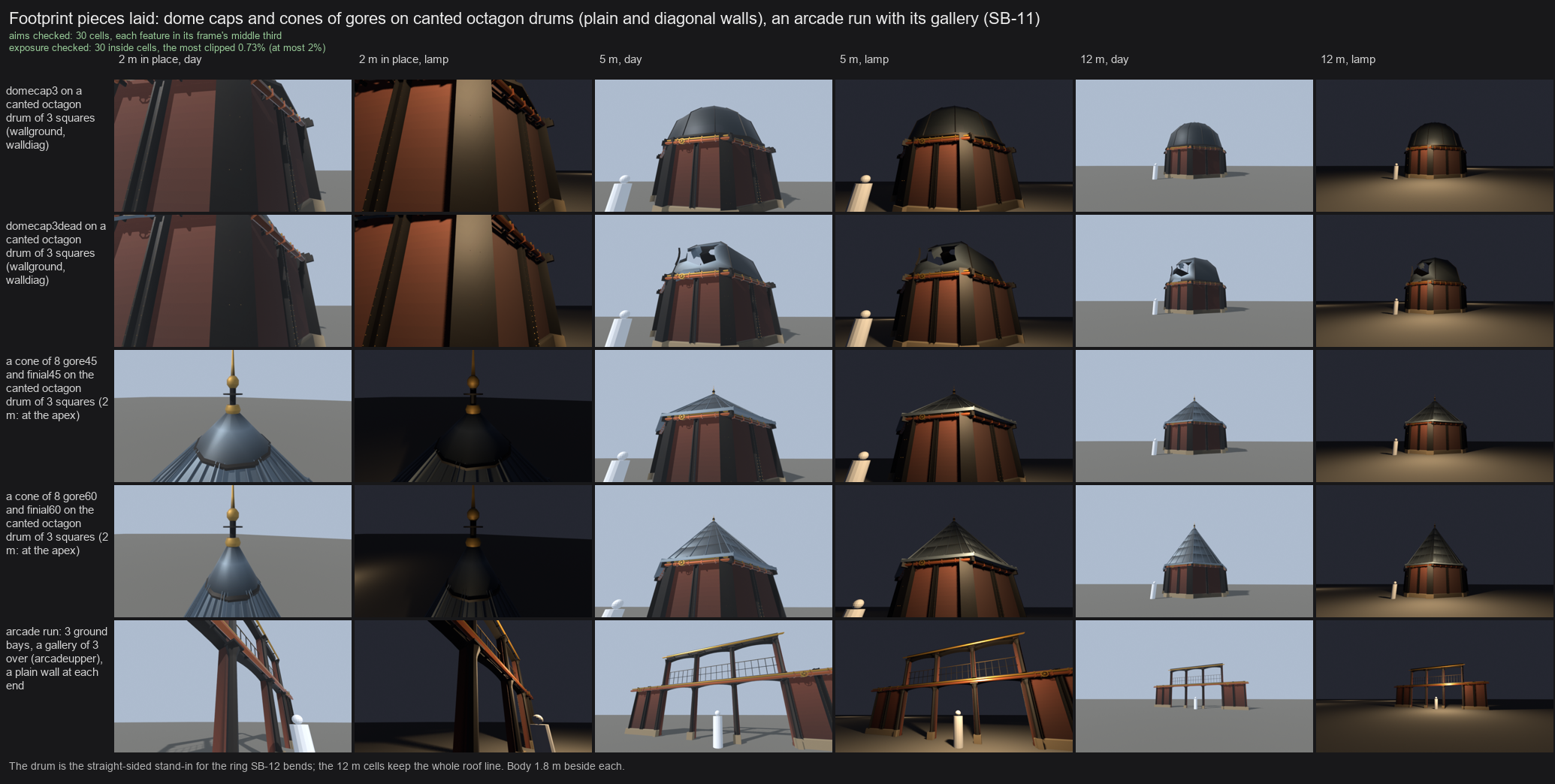
The first version of a dead dome was a sound cap that had slumped, with smooth plates and a clean edge. The review said it read as a sloped roof, which is a different roof and not a fallen one. Nothing was torn, there was no hole and no dark inside.
The fix was a proper break. The cap gets a torn, toothed edge and a hole opened into the drum, and the inside of the drum is painted soot so the hole reads dark. Ribs are bent up past the shell and a plate hangs. At 5 m you see the broken skyline and the dark notch, and it still reads at 12 m. The lesson was that a break has to show a broken edge and a dark hole at 5 m. A torn edge that faces away from the camera isn’t a break either, so the laid sheet has to be angled to show the hole.
The cones had the same problem in a different way. A gore is only proven by its ring, so I laid a cone of eight on the octagon drum. The standing seam blue-grey is the cover the lean-to and porch roof already wear, so the cone, the brass finial and the copper pipe band read as one house.
What is still wrong?
The hanging plate on the dead dome still reads as cut card, because it has no thickness or dark underside. The domes’ 2 m close-ups look at the wall and not the cap. The gallery has no guard across its ends, above the one-storey end walls. Nothing can reach the gallery yet, but the first change that lays an arcade has to close the ends first. The pipe band’s ends stick a little past the corner columns on the diagonal wall.