Walking and flying round a test field of thirty buildings
A double-click launcher lays thirty of the kit's buildings on the test island's flattest spot, to walk round, fly over and watch at night.
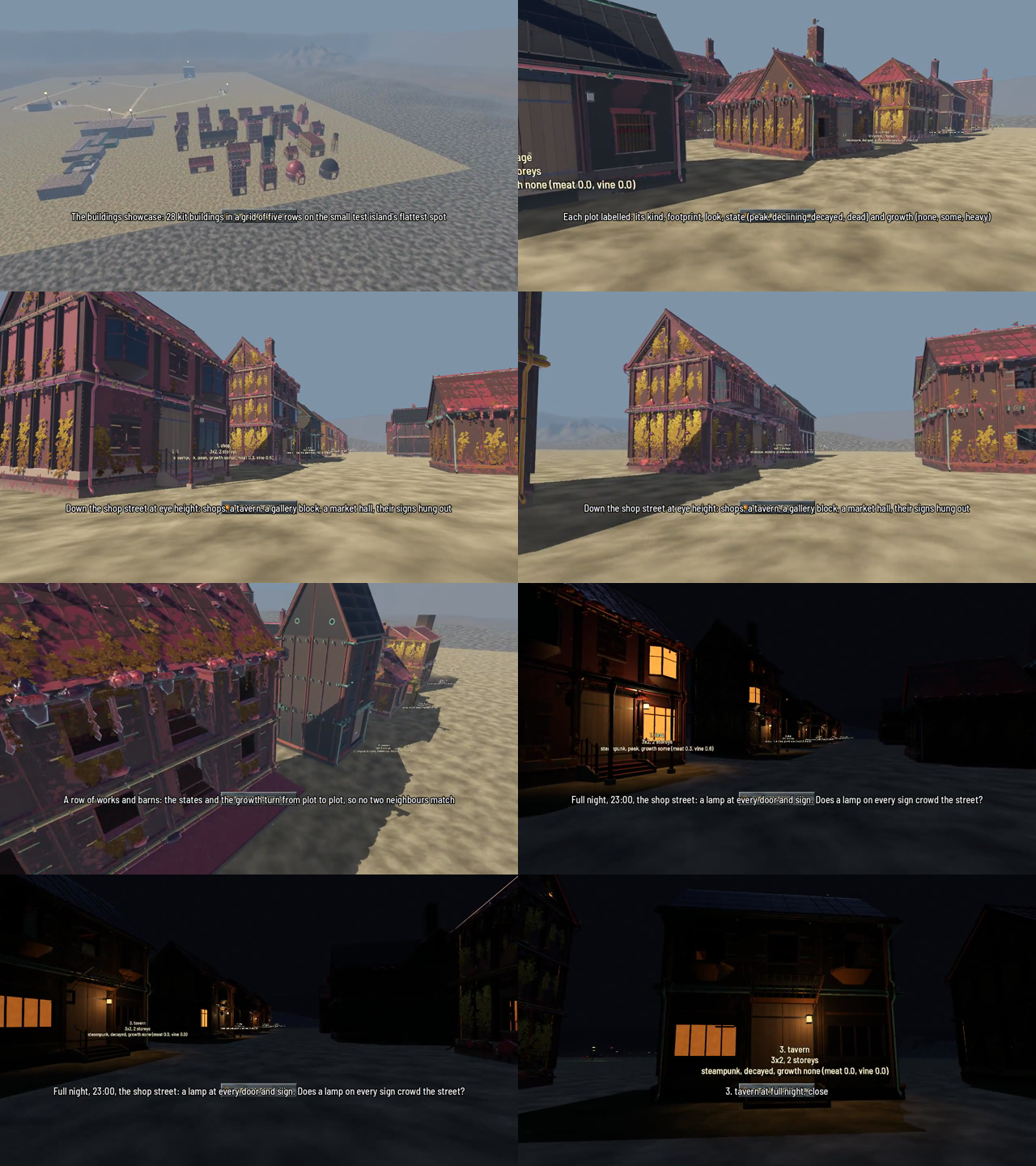
There is now a place to look at the buildings together. Double-click showcase_buildings.bat and the game opens on the small test island with thirty of the kit’s buildings in five rows, each with a label saying what it is. You can walk round them or fly. It is a tool for looking, not a feature of the game, and it writes no saves.
Why did I want a field of buildings?
I asked for “a quick test area for me to look at”, and said “make sure I can switch between walking and flying mode”. Until now the buildings had been checked one at a time, in tests and in separate films. This puts a whole spread of them next to each other, laid the way the game lays them.
What is on the field?
Five rows of six plots. The shop street has shops, a tavern, a gallery block and a market hall. The second row is houses of each footprint, from a plain rectangle to a sixteen-square plan. The third has rowhouses, a long terrace, a tenement, a tower house with a turret, a longhouse with an apse, and a dead house. The fourth is the works and barns, and the fifth has a watchtower, a gatehouse, a rotunda, an octagon and two plots that ask for the house look. That is 22 kinds in all.
Each plot is a request to the same building recipe the rest of the game uses, and each is laid as one building cell, the game’s assembly. So whatever look gets installed later shows up on the field with no change to it. The wear and growth turn from plot to plot, so no two neighbours match: peak, declining, decayed and dead, and growth of none, some or heavy. The label gives the number, kind, footprint, storeys, look, state and the meat and vine amounts.
What do the keys do?
V switches between walking and flying. Walking is the game’s first-person walk, with gravity and collision. Flying is a free camera with none. The wheel, or the apostrophe and semicolon keys, sets the speed. Page Down and Page Up go from plot to plot, standing in front of a plot when walking or over it when flying. The keys 1 to 5 go to the start of a row, 6 looks over the whole grid, and T, Y and P step the clock by an hour or a day and stop it, so a street can be seen at night.
Finding the flattest spot
The grid is 111 by 138 m, so it needs level ground. The code samples the island’s height on an 8 m grid, slides a window the size of the grid across it, and keeps the window where the ground rises and falls least, staying 20 m clear of every marker. It then measures the winner again more finely. The ground under the grid rises and falls 0.00 m. Each building sits on the highest ground under its own footprint.
What is missing?
The film was made before the house look was installed. So 28 of the 30 plots are laid, and the two house plots are skipped with a printed line. When the look is installed they appear on their own. The test and the film are to be run again then.
Why is it in the launcher package?
The field turns the save system off, so it never writes over a player’s saves. No level code does that, so by the project’s package rule it is part of the launcher, not the level package. That was a one-line follow-up commit.
Numbers
- 30 plots asked, 28 laid, 2 skipped, 22 kinds.
- The new test passes 531 checks with none failing, and the building group of the suite passes 18 tests with none failing.
- The change touches 15 files, with 757 lines added and 12 removed.